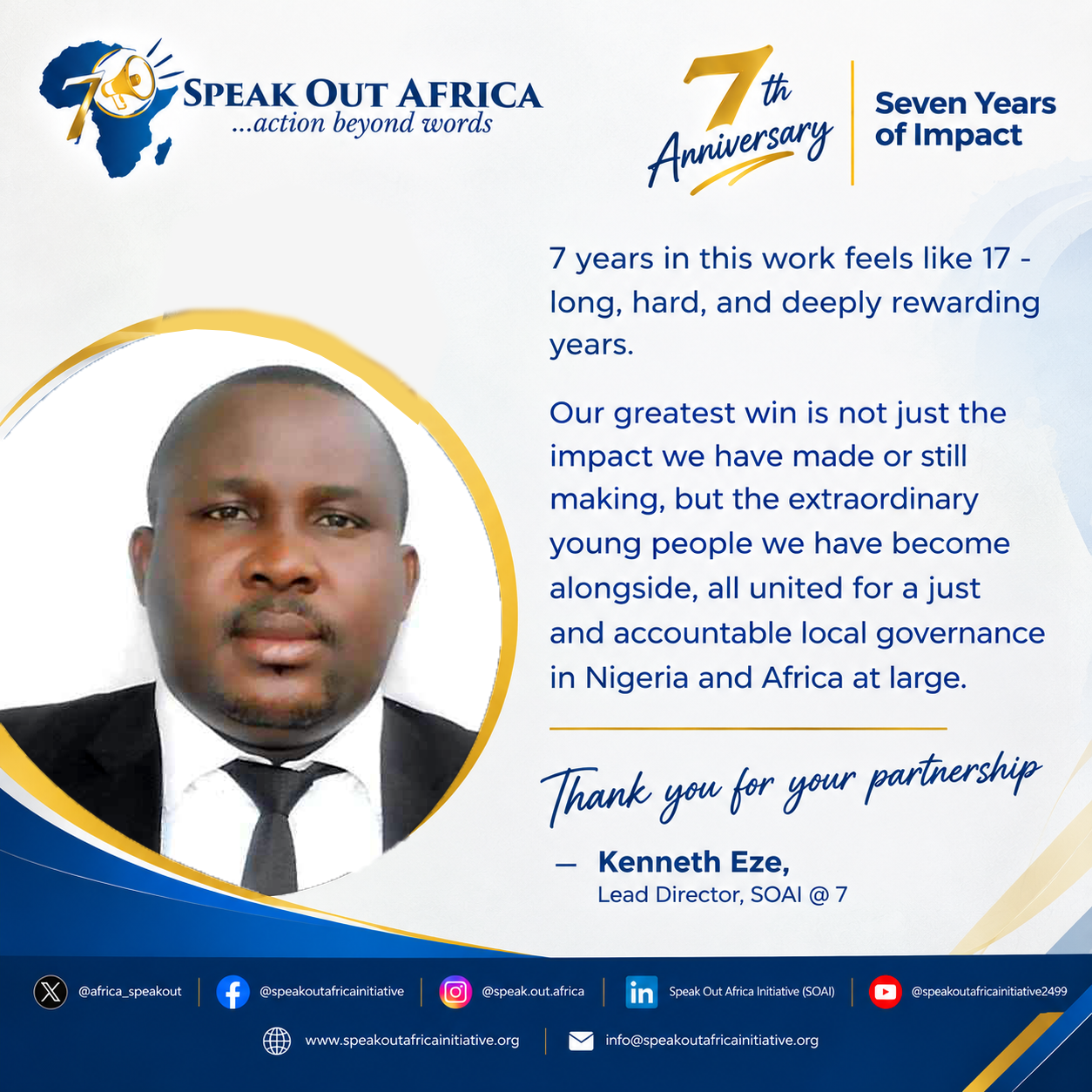
A Commemorative Review of the Speak Out Africa Initiative (SOAI) at 7, its Transformed Grassroots Models, Media Advocacy toward the 2027 General Elections, and Expanded Multi-Sectoral Strategic Alliances
EXECUTIVE INSTITUTIONAL PROFILE AND SEVEN-YEAR GENESIS
The democratic ecosystem of Nigeria's Fourth Republic has long been characterized by a profound paradox: an intensely engaged electorate at federal levels contrasting with deep opacity and structural alienation within subnational and local tiers. Established with a radical vision to systematically decentralize public accountability and institutionalize data-driven governance, the Speak Out Africa Initiative (SOAI) celebrates seven years of transformative intervention as a vanguard Non-Governmental Organisation. Led by its progressive directorate-comprising Engr. Kenneth Eze (Lead Director), Tsavnande Michelle Mimi (Co-founder), and Dr. Asonibare Femi (Head of Programs)-SOAI has successfully engineered platforms that move public accountability from distant federal offices directly into the hands of local communities across Nigeria.
Over the past seven years, SOAI's core operational methodology has evolved from baseline advocacy into a highly sophisticated mix of civic-tech tracking, structural legal auditing, strategic multi-sectoral institutional partnerships, and extensive nationwide media mobilization. Today, the organization stands at the forefront of civic readiness, preparing the country for the upcoming 2027 General Elections through intensive, daily media tracking, voter orientation, and structural defense frameworks for marginalized groups.
CORE PROGRAM ARCHITECTURE AND CHRONOLOGICAL PROJECTS
Since its inception, SOAI has conceived, deployed, and scaled a diverse array of specialized projects, each engineered to address specific gaps within Nigeria's socio-political and civic framework:
- LOGINaija (Local Governance Accountability and Openness Tracker): As SOAI's signature open-governance model, LOGINaija tracks Federal Account Allocation Committee (FAAC) monthly disbursements down to subnational entities. It pioneered the deployment of dedicated local transparency portals and Freedom of Information (FOIA) tracking benches. Pilot implementations across Gwagwalada Area Council (FCT), Umuahia North LGA (Abia), and Ibadan South-West LGA (Oyo) successfully moved fiscal oversight from state capitals to local communities, empowering indigenous community development associations to track actual capital execution against local council budgets.
- Skool 'n' Skill 4 Naija (Civic Education & Technical Empowerment): Funded through a strategic grant from the European Union (EU) and executed in operational partnership with the Koslivia Development Initiative (KODI) in Delta State, this project addresses the intersection of youth unemployment and civic disenfranchisement. It deployed a specialized curriculum blending advanced digital literacy with evidence-based anti-drug advocacy. The project established permanent local training hubs that provide youth with technical skills while instilling a deep sense of constitutional responsibility and community leadership.
- The #GETSAFE Project & SAVE-FCT Campaign: Designed to address evolving modern threats, the #GETSAFE initiative directly combats Technology-Facilitated Gender-Based Violence (TFGBV), tracking digital harassment and providing tech-legal support infrastructure for vulnerable women. Concurrently, the SAVE-FCT Campaign focuses on physical security and grassroots safety, mobilizing transport unions and installing public safety monitors across motor parks to disrupt 'One-Chance' criminal syndicates in the Federal Capital Territory.
- Climate Resilience and Agrarian Innovation: Operating through its West African regional hub, Green-2-Growth Gambia (SOAIG), the initiative has successfully pioneered waste-to-wealth agricultural models. This project trains smallholder farmers in circular economic practices, links community environmental management with micro-scale maternal and infant nutritional intervention frameworks, and establishes local resilience models against climate-induced resource conflicts.
AMPLIFIED MEDIA ADVOCACY: THE REASON2VOTE CAMPAIGN AHEAD OF THE 2027 ELECTIONS
A critical cornerstone of SOAI's recent operational expansion is its unrelenting nationwide media mobilization framework, spearheaded by its flagship campaign, Reason2Vote. As Nigeria navigates the political roadmap toward the crucial 2027 General Elections, SOAI has scaled its media presence to unprecedented levels, securing broadcast features sometimes 2 to 3 times per day across premier national and international live television networks and radio stations, including Africa Independent Television (AIT), News Central, Channels Television, and the Radical Broadcast Network (RBN).
Through this massive, ongoing broadcast footprint, SOAI drives critical national conversations and behavioral transformation across three integrated socio-political priorities:
- Women and Youth Political Participation: Systematically dismantling the historic 'token inclusion' structures by demanding measurable candidate quotas within political party primary guidelines ahead of the 2027 cycle, transforming women and youth from mere mobilizers into direct ballot-seeking contenders.
- Women, Youth, and Gen-Z Leadership: Cultivating the next generation of institutional leaders by creating formalized leadership pipelines, digital civic sandboxes, and mentoring networks that bridge veteran policymakers with modern Gen-Z change agents.
- Women-Youth Socioeconomic Transformation: Advocating for structural economic equity by aligning political participation directly with financial independence, entrepreneurial skill-building, and localized access to capital, thereby insulating the vulnerable youth and female demographic from manipulative electoral commercialization and vote-buying syndicates.
CHANNELS OF POLICY INFLUENCE AND THREE-TIER IMPACT DATA
The operational impact of SOAI over the last seven years is verified by clear data and measurable progress across all three tiers of Nigerian governance:
- National Level Impact: Through the deployment of the CRIG.ng Governance Tracker, SOAI has actively influenced policy conversations surrounding the cost of governance. By mobilizing over 1,405 indigenous election radar officers across the 36 states and the FCT during major electoral cycles, SOAI's empirical observer datasets have been integrated into national legislative reviews on electoral guidelines and data protection protocols.
- State Level Impact: Operating through its Civic Space Resource Hub, SOAI has trained and certified over 320 distinct Civil Society Organisations (CSOs). It successfully integrated civic awareness and social safeguard frameworks into state-level educational and development guidelines across multiple geopolitical zones.
- Local Government Level Impact: Following the Supreme Court judgment on local government financial autonomy, SOAI systematically established 72 active transparency/FOIA desks across target LGAs. These desks ensure that grassroots communities can directly review local capital expenditures, resulting in an institutional footprint that has positively impacted over 185,000 direct and indirect community beneficiaries.
COMPREHENSIVE STRATEGIC PARTNER AND STAKEHOLDER MATRIX
SOAI's systemic reach and policy execution are sustained by an extensive network of high-level national, international, and governmental partners. The table below outlines the institutional matrix underpinning SOAI's interventions:
| Partner / Stakeholder Category | Key Institutional Entities | Primary Domain of Collaboration & Project Alignment |
|---|---|---|
| International Foundations | MacArthur Foundation, Ford Foundation, Open Society Foundations (OSF), Luminate Group, European Union (EU). | Core institutional grant funding, open-governance technology scaling, and international civic space protection frameworks. |
| Federal Executive Ministries | Federal Ministry of Women Affairs, Federal Ministry of Education, Federal Ministry of Finance, Federal Ministry of Justice. | National gender mainstreaming policy design, youth civic curriculum integration, budget transparency tracking, and statutory human rights compliance. |
| Judicial & Legal Institutions | Federal High Court of Nigeria, Office of the Attorney General of the Federation. | Development of judicial administrative capacity, structural legal audits, and court-level digital document handling orientation models. |
| Anti-Corruption Agencies | Independent Corrupt Practices and Other Related Offences Commission (ICPC). | Joint local transparency tracking, deployment of whistleblowing protection guidelines, and anti-graft oversight within municipal councils. |
| Financial Treasury Units | Office of the Accountant General of the Federation. | FAAC allocation visibility mapping and localized data-mining verification frameworks under the LOGINaija project. |
| Higher Education Regulators | National Universities Commission (NUC), National Commission for Colleges of Education (NCCE). | Mainstreaming Sustainable Procurement, Environmental and Social Standards Enrichment (SPESSE) and structural civic modules into tertiary systems. |
| Security & Law Enforcement | National Agency for Prohibition of Trafficking in Persons (NAPTIP), FCT Police Command, POCACOV. | Joint response structures against TFGBV, community-policing dialogue integration, and urban anti-'One-Chance' syndication enforcement. |
| Data Protection Authorities | Nigeria Data Protection Commission (NDPC). | Regulatory alignment for digital civic-tech platforms and safe handling of open-governance biometric and electoral observer registries. |
| Municipal & Local Leadership | Association of Local Government of Nigeria (ALGON). | Direct entry alignment for the 774 LGAs, establishing transparency desks, and council-level public sector efficiency programs. |
| Regional Grassroots Coalitions | Koslivia Development Initiative (KODI), Local Community Development Associations (CDAs). | Direct community-level project mobilization, deployment of technical training camps, and neighborhood security-peace monitoring. |
PAN-AFRICAN EXPANSION AND TRANSNATIONAL FOOTPRINT
Marking its seven-year milestone, the Speak Out Africa Initiative (SOAI) has successfully transitioned from a localized Nigerian civic intervention into a prominent continental actor. Recognizing that the structural challenges of governance deficits, youth marginalization, gender exclusion, and data opacity are shared regional struggles, the initiative has systematically expanded its institutional footprint across sub-Saharan Africa. Today, SOAI maintains fully operational offices, regional hubs, and active project networks in five strategic African nations:
- Nigeria (West African Headquarters): Serves as the central command node for the initiative’s digital civic-tech software development (LOGINaija), legislative advocacy, and the massive Reason2Vote multi-media pre-election sensitization campaigns.
- South Africa (Southern African Bureau): Focuses primarily on institutional programs for Women, Youth, and Gen-Z Leadership, establishing democratic accountability metrics, and curbing economic vulnerabilities through structured youth socioeconomic transformation models within urban and peri-urban hubs.
- Gambia (West African Coastal Hub): Hosts the signature Green-2-Growth Gambia (SOAIG) model, leading local interventions in climate-resilience, waste-to-wealth agricultural systems, and grass-roots maternal and infant health-nutrition advocacy.
- Sierra Leone (Mano River Union Secretariat): Focuses heavily on strengthening citizen-led transparency at the grassroots municipal level, adapting LOGINaija’s local open-governance blueprints to assist subnational councils in implementing robust Freedom of Information Act (FOIA) frameworks.
- Kenya (East African Regional Directorate): Drives collaborative digital tracking platforms and cross-border civic networks, leveraging East Africa's advanced mobile technology ecosystem to promote youth political participation and gender-mainstreamed public budget tracking.
Through this unified five-nation deployment, SOAI does not merely operate in isolation; it actively facilitates the cross-border sharing of civic innovations, policy frameworks, and local governance accountability mechanisms, cementing its status as a foundational pillar of modern pan-African democratic development.
TIMELINE FOCUS AND CONCLUSION: TOWARD THE 2027 GENERAL ELECTION AND BEYOND
As the Speak Out Africa Initiative marks its seventh year of institutional growth, its trajectory reflects a profound shift from a localized monitoring hub to a critical pillar of national accountability and social justice. By combining ground-level tracking via project desks with extensive daily broadcast mobilization on AIT, Channels TV, News Central, and RBN, SOAI has built a robust bridge between civil society, federal statutory institutions, and local communities.
Looking toward the 2027 General Elections, the organization's focus remains steady. Backed by its partnerships with ministries, regulatory commissions, anti-graft bodies, and municipal associations, SOAI continues to expand its open-governance networks. By ensuring the inclusion of women, youth, and Gen-Z leaders in decision-making spaces, the Speak Out Africa Initiative is helping shape a mature, transparent, and resilient democratic culture for Nigeria.