By Mate Fisayomi Toluwalase
Editor | Speak Out Africa Initiative (SOAI)
Imagine waking at 4:00 AM in a Harare township the morning air bites cold, yet there is no time to linger. The arithmetic of survival begins before sunrise, a monthly wage of roughly US$250 collides with the brutal reality that feeding, sheltering, and clothing a family of five now costs over US$450. To bridge this chasm, you spend your days side-hustling in the informal economy vending on dusty streets, hauling goods, or praying that a relative abroad sends a small remittance. This is the rhythm of life for millions of Zimbabweans waking before dawn, working until exhaustion, yet never quite catching up.
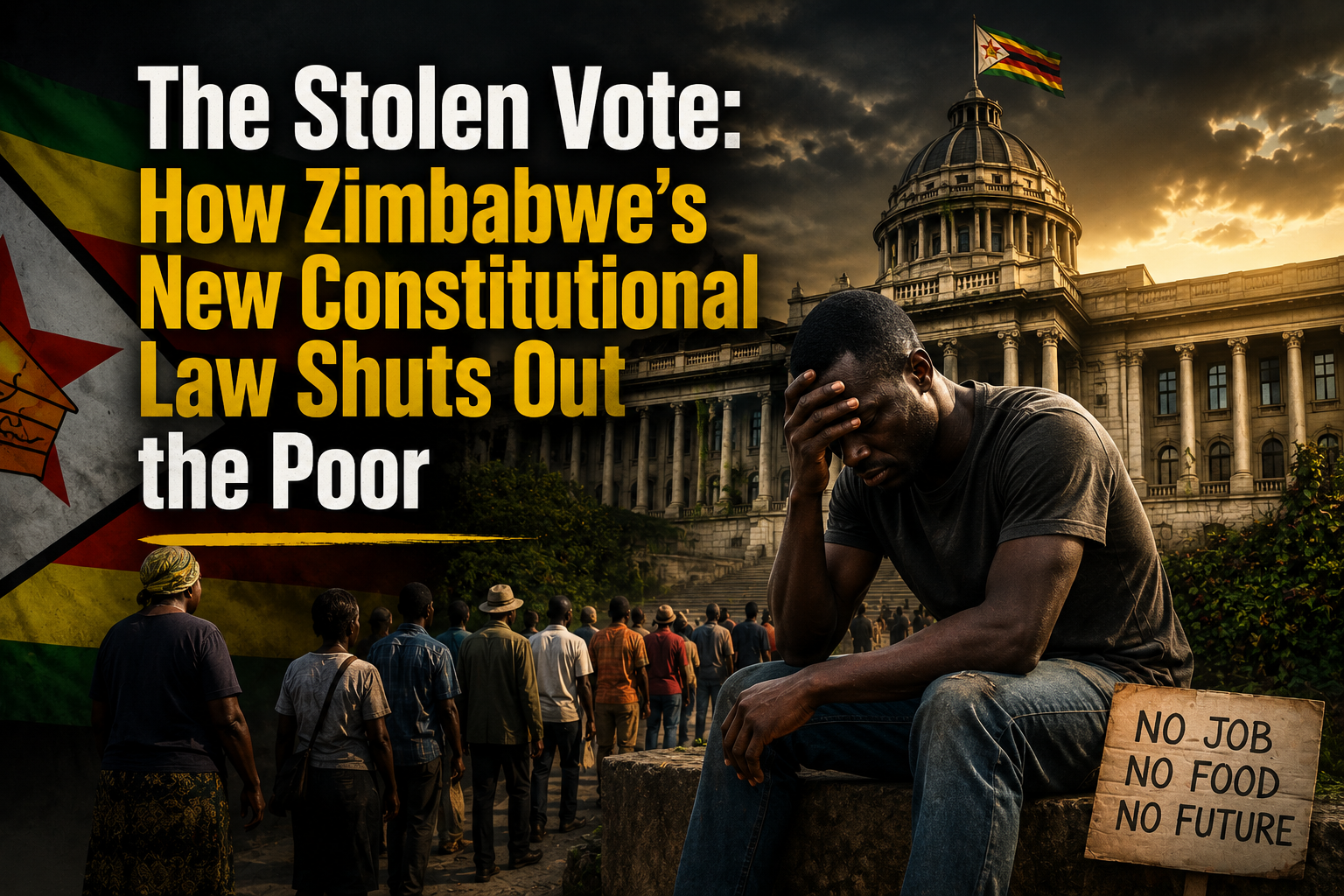
On a day that will be remembered as a turning point in Zimbabwe's troubled democratic journey, President Emmerson Mnangagwa signed Constitutional Amendment No. 3 into law. The legislation eliminates direct presidential elections, replacing them with a system where parliament selects the head of state. In a single stroke, the foundational democratic principle of one person, one vote has been obliterated. The stated justification cost-saving and administrative efficiency rings hollow against the backdrop of a ruling party that has consistently prioritized its own survival over the welfare of its citizens. When a government no longer answers to the ballot box, it has no incentive to address the concerns of ordinary citizens. Public services become the first casualty. A ruling class that is self-appointed will always prioritize self-enrichment and elite patronage over the survival of the masses.
To justify this power grab, the state relies on a carefully constructed narrative of progress. Official communications point to the introduction of the gold-backed ZiG currency, agricultural recovery, and rising mining output as evidence that Zimbabwe is on the path to prosperity. But this recovery is a statistical fiction designed to pacify an exhausted working class. The elite offer a false bargain: accept the loss of political sovereignty in exchange for a modicum of economic predictability. The wage gap remains catastrophic. The ZiG currency may have temporarily slowed hyperinflation, but it has not put money in the pockets of the poor. The average formal wage of US$250 to US$300 is woefully inadequate against the US$450 cost-of-living threshold. Meanwhile, the mining boom generates enormous wealth that never reaches the townships. Instead, profits are extracted by multinational corporations and ZANU-PF aligned elites, leaving local communities with environmental degradation and empty promises. Hunger persists beneath the surface of official statistics. While famine has receded from emergency levels, deep malnutrition remains a daily reality for millions. Rural and urban families alike rely on food aid or face severe food insecurity during the lean seasons.
The new law does not resolve the deep fractures within the ruling party it detonates them. By extending President Mnangagwa's tenure to 2030 and replacing direct presidential elections with parliamentary selection, the amendment blocks any constitutional path to the presidency for Vice President Constantino Chiwenga. The implicit agreement made during the 2017 military intervention that Mnangagwa would serve as a transitional leader before handing power to the military-backed Chiwenga has been systematically torn up. What remains is a highly volatile power struggle at the top of the state. The working class must not be passive spectators to this elite conflict, nor should we fall into the trap of supporting one faction over another. History is a brutal teacher. In 2017, when the military intervened to depose Robert Mugabe, many celebrated. That military intervention did not bring democracy; it simply installed a different faction of the same capitalist elite. A military-backed takeover will not fix our schools, open our clinics, or raise our wages. It will only deepen the authoritarian nature of the state and escalate repression against independent popular movements.
The crisis in Zimbabwe is not contained within its borders; it is a regional catastrophe. Over 1.5 million Zimbabweans currently live in South Africa, having fled decades of economic collapse. They are not "economic tourists they are workers who have been forced to leave their homes to survive. In South Africa, this migration has been weaponized by the ruling political class. Faced with the catastrophic failures of their own neoliberal policies which have left South African unemployment hovering near 32% politicians have cynically scapegoated Zimbabwean and other migrant workers. Xenophobic organizations like Operation Dudula have turned South African workers against their Zimbabwean brothers and sisters. This is a classic divide-and-rule strategy. The enemy of the South African worker is not the Zimbabwean immigrant; the enemy is the capitalist system that breeds poverty, unemployment, and exploitation on both sides of the Limpopo River.
The Constitutional Amendment has been signed into law, but no law can withstand the organized power of the working class. To defeat this assault on our future, we must build a unified, militant fightback across four major fronts. First, we cannot rely on capitalist opposition parties or professional politicians to save us. The working class must organize itself independently, building democratic committees in every factory, mine, farm, township, and informal marketplace. These organizations must connect the immediate fight for basic democratic rights with the broader struggle for living wages, clean water, healthcare, and economic justice. Second, the Zimbabwe Congress of Trade Unions and all progressive labour formations must reclaim their historic role as the vanguard of the struggle. Unions cannot limit themselves to narrow wage negotiations while the state strips away the fundamental rights of the people. The organized labour movement must call for mass action against the Amendment, building powerful coalitions with student movements, civil society, informal traders, and the rural poor. Third, the struggle against the ZANU-PF dictatorship is an international struggle. The global labour movement must stand in active solidarity with the Zimbabwean people, pressuring regional bodies like SADC, demanding diplomatic isolation of the regime, and exposing human rights abuses. Fourth, we must build a powerful regional alliance of the working class across Southern Africa, rejecting the poison of xenophobia and recognizing our shared class interests.
To truly solve the crisis in Zimbabwe, we must look beyond the restoration of formal voting procedures. Even if we win back the direct vote, as long as the factories, mines, and agricultural lands are owned by corrupt politicians and foreign multinational corporations, the working class will remain trapped in poverty. We need a fundamental transformation of our society. We need a socialist alternative where the resources and wealth of Zimbabwe are owned, controlled, and democratically managed by the working class and the poor who produce them. A socialist Zimbabwe would mean placing major industries, mines, and agricultural lands under democratic workers' control to serve human needs, not private profit. It would mean prioritizing the building of state-of-the-art public hospitals and paying doctors and nurses a dignified living wage to halt the brain drain. It would mean guaranteeing clean, running water, electricity, and decent housing for every family in the townships and rural areas. And it would mean ending the exploitation of the informal economy by generating formal, unionized jobs with strong labour rights and comprehensive social safety nets.
The elite have signed their law in the halls of parliament, but the ultimate power to shape history lies in the hands of those who build the roads, mine the gold, and harvest the crops. No constitutional amendment can withstand the organized power of the working class. We have the numbers, the resilience, and the vision. What we lack is organization and unity. It is time to shake off our exhaustion, organize our communities, and build a working-class democratic future. The stolen vote can be reclaimed, but only if we are willing to fight for it. The future of Zimbabwe belongs to its workers and its poor not to the elite who have stolen our country and our future